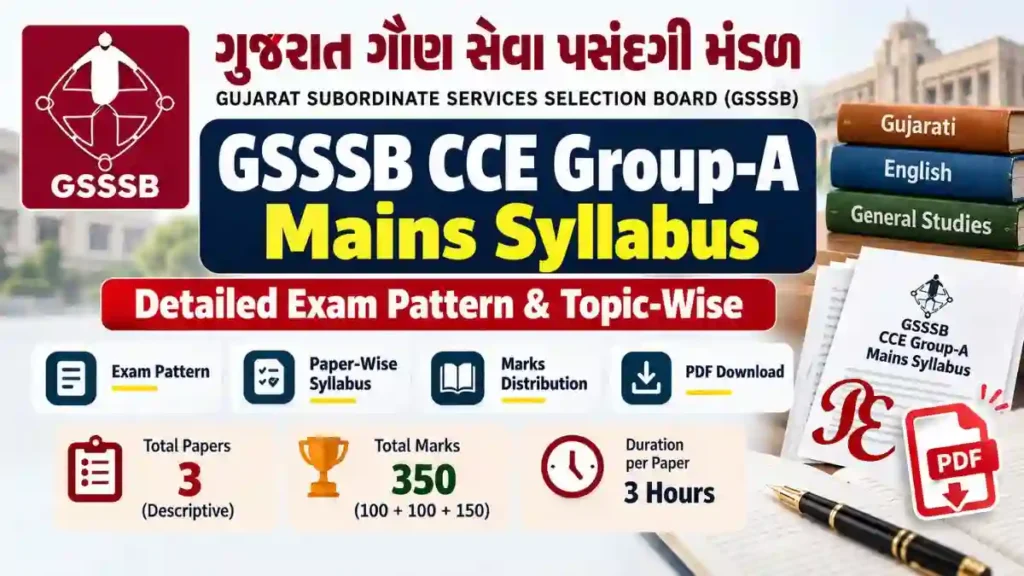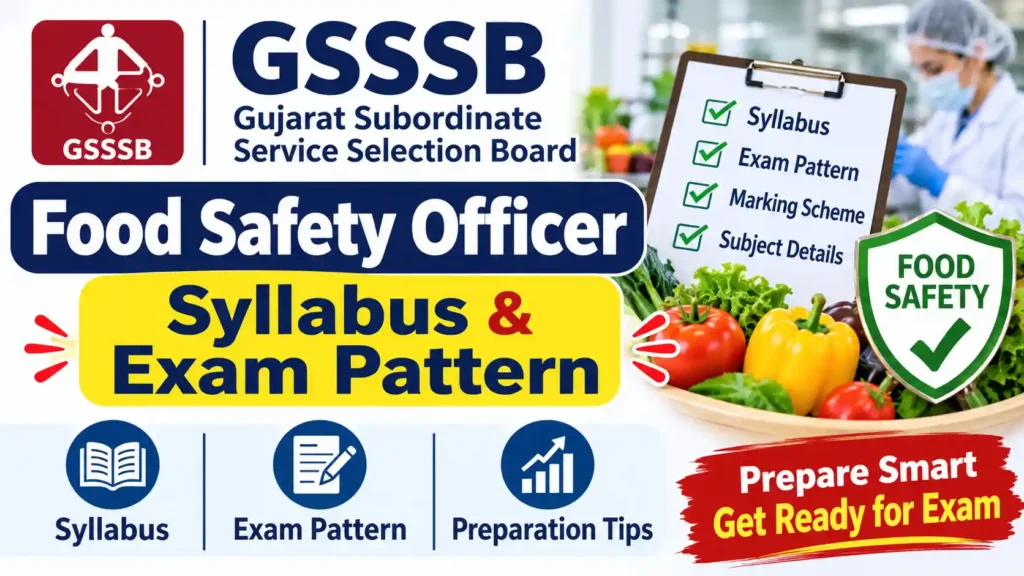
GSSSB Food Safety Officer Syllabus: ગુજરાત ગૌણ સેવા પસંદગી મંડળ (GSSSB), ગાંધીનગર દ્વારા Food Safety Officer (Class-3 / ફુડ સેફ્ટી ઓફિસર, વર્ગ-૩) સંવર્ગની સ્પર્ધાત્મક કસોટીનો વિગતવાર અભ્યાસક્રમ પ્રસિદ્ધ કરવામાં આવ્યો છે.
આ લેખમાં Part-A (90 Marks) અને Part-B (120 Marks) નો સંપૂર્ણ ટોપિક-વાઈઝ તથા યુનિટ-વાઈઝ ગુણભાર સાથેનો અભ્યાસક્રમ સરળ સમજ માટે આપેલ છે.
GSSSB Food Safety Officer Exam Pattern Overview
સ્પર્ધાત્મક પરીક્ષા MCQ (CBRT / OMR) પદ્ધતિમાં એક તબક્કામાં લેવામાં આવશે, જેમાં Part-A અને Part-B મળીને કુલ 210 Questions / 210 Marks અને સમયગાળો 3 Hours (180 Minutes) રહેશે:
| Exam Section | Subjects / Technical Area | Questions & Marks |
| Part – A (1) | Reasoning & Data Interpretation (તાર્કિક કસોટીઓ તથા ડેટા ઇન્ટરપ્રિટેશન) | 30 Questions / 30 Marks |
| Part – A (2) | Quantitative Aptitude (ગાણિતિક કસોટીઓ) | 30 Questions / 30 Marks |
| Part – A (3) | Constitution of India (ભારતનું બંધારણ) | 10 Questions / 10 Marks |
| Part – A (4) | Current Affairs (વર્તમાન પ્રવાહો) | 10 Questions / 10 Marks |
| Part – A (5) | Comprehension – Gujarati (5 Marks) & English (5 Marks) | 10 Questions / 10 Marks |
| Part – B | Questions & Applications related to Technical / Educational Qualification | 120 Questions / 120 Marks |
| Total | Combined Duration: 3 Hours (180 Minutes) | 210 Questions / 210 Marks |
- Negative Marking: ખોટા જવાબ માટે પ્રશ્નના ગુણના 1/4 (0.25) માર્ક કપાશે.
- Language Rule: Part-A (Constitution & Current Affairs) અને Part-B ના પ્રશ્નો Gujarati અને English બંને ભાષામાં રહેશે, જ્યારે Gujarati Comprehension માત્ર ગુજરાતીમાં અને English Comprehension માત્ર અંગ્રેજીમાં રહેશે.
Part – A Detailed Syllabus (90 Marks)
1. Reasoning & Data Interpretation (30 Questions – 30 Marks)
- Coding-Decoding (કોડિંગ-ડિકોડિંગ)
- Blood Relation (લોહીનો સંબંધ)
- Problem on Age and Height (ઊંમર અને ઊંચાઇ સંબંધિત પ્રશ્નો)
- Direction Knowledge (દિશા જ્ઞાન)
- Clock and Calendar (ઘડીયાળ અને કેલેન્ડર)
- Venn Diagram (વેન ડાયાગ્રામ)
- Rank and Position (ક્રમ અને સ્થાન)
- Arithmetic Progression (સમાંતર શ્રેણી)
- Logical Sequence of Words (શબ્દોની તાર્કિક ગોઠવણી)
- Insert the Missing Character (ખૂટતી કડી / સંખ્યા શોધો)
- Word, Numerical and General Analogy (શબ્દ, આંકડાકીય તથા સામાન્ય સામ્યતા)
- Picture Based General Logical Questions / Visual Reasoning (ચિત્ર આધારિત સામાન્ય તાર્કિક પ્રશ્નો)
- Probability (સંભાવના)
- Data Interpretation (Charts, Graphs, Tables) and Data Sufficiency (માહિતીનું અર્થઘટન અને માહિતીની પર્યાપ્તતા)
- Symmetry (સંમિતિ)
- Mathematical Operations (ગાણિતિક ક્રિયાઓ)
- Mathematical Modeling (ગાણિતિક મોડેલીંગ)
- Proofs in Mathematics (ગણિતમાં સાબિતીઓ)
- Logical and Mathematical Analytical Ability (તાર્કિક અને ગાણિતિક વિશ્લેષણાત્મક ક્ષમતા)
- Statement and Prediction (નિવેદન અને અનુમાન)
2. Quantitative Aptitude (30 Questions – 30 Marks)
- Number System (સંખ્યા પદ્ધતિ)
- LCM and HCF (લ.સા.અ. અને ગુ.સા.અ.)
- Percentage and Partnership (ટકાવારી અને ભાગીદારી)
- Profit-Loss (નફો-ખોટ)
- Simple and Compound Interest (સાદુ અને ચક્રવૃદ્ધિ વ્યાજ)
- Ratio and Proportion (ગુણોત્તર અને પ્રમાણ)
- Time and Work, Wages and Chain Rule (સમય અને કાર્ય, વેતન અને સાંકળનો નિયમ)
- Time, Speed and Distance (સમય, ઝડપ અને અંતર)
- Average, Mean, Mode and Median (મધ્યક, મધ્યસ્થ અને બહુલક)
- Brackets and Expansions (કૌંસ અને વિસ્તરણ)
- Square and Square Roots, Cube and Cube Roots, Exponents (વર્ગ અને વર્ગમૂળ, ઘન અને ઘનમૂળ, ઘાત અને ઘાતાંક)
- Polynomials and Factorisation (બહુપદીઓ અને અવયવીકરણ)
- Pair of Linear Equations in Two Variables and Quadratic Equations (દ્વીચલ સુરેખ સમીકરણ અને દ્વિઘાત સમીકરણ)
- Area, Surface Area and Volume – Square, Rectangle, Triangle, Circle, Cube, Cuboid, Cylinder, Cone, Hemisphere, Sphere (ક્ષેત્રફળ, પૃષ્ઠફળ અને ઘનફળ)
- Coordinate Geometry and Trigonometry (યામભૂમિતિ અને ત્રિકોણમિતિ)
3. Constitution of India (10 Questions – 10 Marks)
- Concept of Political Science (રાજ્યશાસ્ત્રનો ખ્યાલ)
- Preamble of the Constitution (બંધારણનું આમુખ)
- Fundamental Values of Democracy, Nationalism and Secularism, Right and Citizenship (લોકશાહીના પાયાનાં મૂલ્યો, રાષ્ટ્રવાદ અને બિનસાંપ્રદાયિકતા, હક અને નાગરિકતા)
- Indian Constitution Framing and Characteristics (ભારતીય બંધારણ: ઘડતર અને લક્ષણો)
- Fundamental Rights, Duties and Directive Principles of State Policy (મૂળભૂત હકો, ફરજો અને રાજ્યનીતિના માર્ગદર્શક સિદ્ધાંતો)
- Legislature, Executive and Judiciary in India at Union and State Level (કેન્દ્ર અને રાજ્યકક્ષાએ ધારાસભા, કારોબારી અને ન્યાયતંત્ર)
- Government at Local Level: Institutions of Local Self-Government (સ્થાનિકકક્ષાએ સરકાર: સ્થાનિક સ્વરાજની સંસ્થાઓ)
- Nature of Party System in India (ભારતમાં પક્ષપ્રથાનું સ્વરૂપ)
- Elections in India (ભારતમાં ચૂંટણીઓ)
- Indian Democracy: Challenges and Response (ભારતીય લોકશાહી સામેના પડકારો અને પ્રતિભાવો)
- Development and Democracy (વિકાસ અને લોકશાહી)
4. Current Affairs & 5. Comprehension (20 Marks)
- Current Affairs (10 Questions – 10 Marks): Current events of state, national and international importance (પ્રાદેશિક, રાષ્ટ્રીય અને આંતરરાષ્ટ્રીય કક્ષાની મહત્ત્વની સાંપ્રત ઘટનાઓ).
- Comprehension (10 Questions – 10 Marks: Gujarati 5 Marks + English 5 Marks): ગદ્યખંડ (Paragraph) ના આધારે પ્રશ્નો અથવા નિવેદન/અનુમાન (Statement & Assertion) પ્રકારના પ્રશ્નો દ્વારા અર્થઘટન અને સમીક્ષા કૌશલ્યનું મૂલ્યાંકન.
Part – B Unit-Wise Syllabus & Marks Weightage (120 Marks)
Part-B માં શૈક્ષણિક લાયકાતને સંબંધિત વિષય અને તેની ઉપયોગિતાને લગતા 120 પ્રશ્નો (120 ગુણ) પૂછવામાં આવશે. યુનિટ મુજબ સૂચિત ગુણભાર નીચે મુજબ છે:
| Unit No. | Subject / Unit Name | Key Syllabus Topics | Marks |
| Unit 1 | Food Laws, Regulations and Schemes | National Food Law & Standards, FSSAI, Codex Alimentarius, Food Safety & Standards Act 2006, Rules & Regulations 2011, Food Adulteration, Misbranding, FSO Duties, BIS & AGMARK Certification | 30 |
| Unit 2 | Introduction to Basic Food Science | History of Food & Preservation, Traditional Foods, Food Fortification, Eat Right India, Carbohydrates, Proteins, Fats, Vitamins, Minerals, Enzymes, Metabolic Pathways, Digestion & Absorption, Physical/ Chemical/ Colloidal Properties of Food | 20 |
| Unit 3 | Food Microbiology and Food Biotechnology | Micro-organism Classification, Morphology, Physiology & Growth, Food Poisoning & Foodborne Diseases, Toxins, Rapid Detection, Food Fermentation, Spoilage of Specific Food Groups, Microbial Techniques (SPC, TPC), GMOs, Enzyme & Protein Engineering, Alternative Food Production | 15 |
| Unit 4 | Food and Nutrition | Functions, Classification & Sources of Food, Balanced Diet, RDA, Nutritional Status Assessment, Malnutrition, Nutrition & Health Programmes (MDMP, ICDS, National Food Security Mission), Macro & Micronutrient Deficiency Diseases | 05 |
| Unit 5 | Food Preservation, Packaging and Storage | Principles & Methods of Preservation, Thermal & Non-Thermal Tech, Food Packaging Types, Packaging Laws & Packaged Commodities Rules, Novel Packaging, Food Storage Structures & Environment Interaction | 05 |
| Unit 6 | Agricultural Science | Status of Agriculture in India, Traditional & Modern Farming Systems, Cropping Systems, Livestock (Dairy, Piggery, Goats, Poultry, Duckery), Horticulture, Agro-forestry, Aquaculture & Integrated Farming, Value Chains & Secondary Enterprises | 05 |
| Unit 7 | Food Safety, Quality Control, Hygiene & Standards | Food Safety Scope & Factors, Physical/Chemical/Biological Hazards & Risk Management, Hygiene & Sanitation in Food Service, Waste Disposal, Pest & Rodent Control, Personnel Hygiene, PRPs, GHPs, GMPs, SSOPs, HACCP, ISO Series, TQM, FSMS 22000 / ISO 22000:2005 | 15 |
| Unit 8 | Animal Product Processing | Meat Composition & Types, Slaughtering, Tenderization & Curing, Fish & Poultry Processing, Egg Characteristics, Milk & Processed Dairy Products, Milk Adulterants & Detection | 05 |
| Unit 9 | Dairy Science | Milk Composition, Adulterants & Detection, Milk Chemistry, Physical Properties & Microbiology, Unit Operations (Separation, Standardization, Pasteurization, Sterilization, Homogenization, Concentration), Dairy Product Technology, Quality Assurance & Packaging | 10 |
| Unit 10 | Food Processing Technology | Non-Thermal Tech (Micro-Filtration, HPP, Ultra-Filtration, RO, High-Voltage Electric Fields, Cold Plasma), Nutraceuticals, Functional & Junk Foods, Thermal Processing, Pasteurization, Concentration, Dehydration, Canning, Freezing, Fermentation, Irradiation, Food Additives, Aseptic & Hurdle Tech, Hydrostatic Pressure, Microwave, Ohmic/ Dielectric/ Infrared/ Induction Heating | 10 |
| Total | Part – B Technical Syllabus | Questions & Applications related to Educational Qualification | 120 |
Important Exam & Syllabus Notes for Candidates
- English Version Final: ગુજરાતી ભાષાંતર ઉમેદવારોની સમજણ માટે છે; અર્થઘટનના કિસ્સામાં અંગ્રેજી અભ્યાસક્રમ માં દર્શાવેલ બાબતો આખરી ગણવામાં આવશે.
- Indicative Marks: દરેક મુદ્દા/યુનિટ સામે દર્શાવેલા ગુણ સૂચિત ગુણ છે, જેમાં બોર્ડ જરૂર જણાયે ફેરફાર કરી શકે છે.
- Pro-Rata Calculation: ફાઇનલ આન્સર કીમાં કોઈ પ્રશ્ન રદ થાય તો બાકીના પ્રશ્નોના ગુણભારમાં Pro-Rata મુજબ ગણતરી કરવામાં આવશે.
Important Links
| Particulars | Link |
| GSSSB Food Safety Officer Syllabus | Syllabus PDF |
| GSSSB Food Safety Officer Recruitment | View Recruitment |
| Official GSSSB Website | https://gsssb.gujarat.gov.in/ |
Frequently Asked Questions (FAQs)
GSSSB Food Safety Officer પરીક્ષામાં Part-B ના કેટલા ગુણ છે?
Part-B માં શૈક્ષણિક લાયકાત આધારિત વિષય અને ઉપયોગિતાના 120 પ્રશ્નો (120 ગુણ) પૂછવામાં આવશે, જેમાં Unit-1 (Food Laws & FSSAI – 30 Marks), Unit-2 (Basic Food Science – 20 Marks), Unit-3 (Microbiology & Biotech – 15 Marks) અને Unit-7 (Food Safety & Quality Control – 15 Marks) નો સૌથી વધુ ગુણભાર છે.
Part-A માં કયા વિષયોનો સમાવેશ થાય છે?
Part-A (90 Marks) માં Reasoning & Data Interpretation (30), Quantitative Aptitude (30), Constitution of India (10), Current Affairs (10) અને Gujarati + English Comprehension (10) નો સમાવેશ થાય છે.
ગુજરાત સરકારની નવીનતમ ભરતી જાહેરાતો, અભ્યાસક્રમ, કોલ લેટર અને આન્સર કી માટે નિયમિત PravinEdu.com ની મુલાકાત લેતા રહો.